Welcoming Strangers

Text focus: Luke 24:13–35
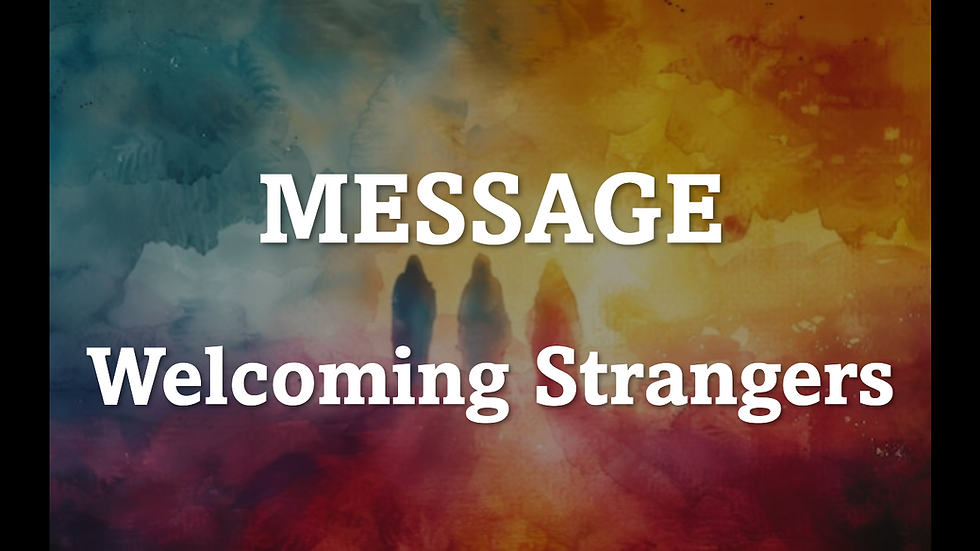
In today’s passage from Luke, we meet two disciples walking on the road to Emmaus. One is named Cleopas. The other is not. Like many of those we encounter, they are not given a name. And I don’t think that’s an accident here.
The unnamed disciple is there so that we might step into the story. So that we might recognize that we are also on that road. Because we know that road, don’t we?
It’s the road of confusion and unanswered questions. The road of grief. The road of trying to make sense of things that don’t make sense.
These disciples are walking away from Jerusalem. The place where they had seen Jesus murdered. They had believed Jesus was the one that was going to bring change. They had followed and trusted him. And now… he’s dead.
Yes, they’ve heard the stories about what had happened over the last couple days, but, in Luke’s Gospel they don’t see Jesus in the garden, a few verses before where our scripture starts the women go to the tomb. When they get there they see angels who tell them Jesus has risen, but the disciples we meet on this road were not there, they don’t understand yet. So they walk in grief and confusion trying to process,
Trying to piece together a truth that still feels out of reach.
And as they walk along that dusty road, a stranger joins them. He doesn’t announce himself or reveal who he is. He simply walks with them. And he asks a question, “What are you talking about?” They respond with surprise, “Are you the only one who doesn’t know what’s happened?” They start telling him about Jesus, this prophet that they knew, they tell the story of the miracles and the crucifixion. But notice what’s missing here.
They don’t call Jesus the Messiah, or the Son of God. They have the information about what he has done, but they lack the understanding about who he really is. To be clear, the disciples didn’t lack the faith to trust Jesus, they were not leaving Jerusalem because they had given up on God, as the theologian Amy-Jill Levine explains, they are working with the information they had, but they lacked the framework to understand resurrection.
The stranger responds to them, not harshly, but with some brutal honestly, “How foolish you are… and how slow to believe.” Not foolish because they are unintelligent, but because they are missing the deeper story, the resurrection is not what they expected, so their expectations are misaligned with reality. And then this stranger, tells the whole story, from creation through the prophets reclaiming it along the way, and rewriting the over-arching narrative of God’s people with a perspective of presence and long working liberation.
And still, even in the teaching, they do not recognize him. He is right there, walking with and talking to them. And they do not see who he is.
And if we are honest… sometimes, neither do we. How often does Christ walk beside us, and we don’t recognize him?
When they reach their destination, the stranger walks as though he is continuing on. And here, in this moment they could have let him go. They could have said, “Well, it was nice talking with you.” But instead, they say, “Stay with us.”
They extend hospitality to welcome the stranger. They make room for this stranger. They set an extra seat at the table. And it’s important to notice that at this point, they still don’t know who he is. They are not welcoming Jesus because he is Jesus. They are welcoming him simply because he is a stranger in need of welcome. And that matters, because it means their act of hospitality is not calculated, strategic, or safe. They don’t know what this man’s intentions might be.
One of my professors in seminary, Dr. Amy Oden helped us understand how the Early Christian identity was rooted in radical hospitality, and I believe that this story is a really important reason as to why. The early Christians welcomed strangers, knowing the risk, but did it anyway because they trusted God. Very simply, their hospitality was faith in action.
So they sit down at the table. And then something unexpected happens. The guest becomes the host. Jesus takes the bread. Now that’s not how it was supposed to work. The host should bless and break the bread. That was the custom.
And so you can almost imagine the moment, can’t you? That awkward pause.
That glance between the disciples as they see him reaching for the bread. The looks that say, “What is he doing?”
But before anything is said, the stranger takes the bread, blesses it, breaks it, and gives it to them.
And in that moment, their eyes are opened. As they accept the bread from this stranger, they see that he is not actually a stranger at all. They recognize him. This man they had walked with, talked with, and welcomed into their home is the same man they had been talking about on the road. The same person they had been grieving. The one they thought was gone.
Let's step back to the moment before their eyes were opened. The moment when they had welcomed him in, not knowing who he was. That moment when they didn’t yet know or understand. That moment when they likely wondered if they had made a mistake because this stranger was breaking custom and acting like the host.
It is this moment of radical hospitality, hospitality that is not always comfortable, that something extraordinary happens.
Their simple act of welcome, their ordinary act of kindness, is returned to them as something far greater than they could have imagined. Because the stranger they welcomed was their friend, their Lord, their Messiah. And suddenly everything changes. Their confusion becomes clarity. Their grief becomes hope. Their despair becomes joy.
This is not just a story of resurrection. It is a story about how we encounter the risen Christ. Because remember, they did not recognize him as they walked, or even while he taught them. They recognized him in the act of radical hospitality. In the breaking of bread. They recognized him because they took the risk of welcoming a stranger.
In Matthew 25 Jesus says, “I was hungry and you gave me something to eat… I was a stranger and you invited me in…Whatever you did for the least of these… you did for me.”
This, this right here, is that teaching in action. Around the table, strangers become friends. Through hospitality, God is revealed. In a moment of creating space for a stranger, Christ is found.
In that moment of recognition, everything shifts for the disciples. Relief floods in, understanding washes away their confusion, joy rises where grief had settled, and hope is restored in a way they could not have imagined.
But resurrection is never just about insight; it always moves us toward action. And so they do not stay at the table, they do not linger in the comfort of this understanding.
They get up and return to Jerusalem, the road that they had just walked in despair now becomes the path of their proclamation. Because encountering the risen Christ never leaves us where we are, it sends us, with urgency and purpose, to bear witness to what we have seen and now know.
What is true for them is still true for us today. Christ still comes to us disguised in the unfamiliar, the stranger, the overlooked. That is why hospitality is not just about being polite or kind; it is faith in action. It is one of the primary ways we encounter Christ in our daily lives. Hospitality is not optional for Christians; it is central to who we are.
But there is grace in it, we do not need to fully understand before we act. The disciples didn’t have everything figured out when they said, “Stay with us.” Faith, sometimes, looks as simple as opening the door and making room.
And so we are each left to wonder where is God already walking beside me, unseen?
Perhaps in your grief, in your confusion and questions, in an unexpected conversation, or even in an interruption you didn’t plan for.
And what if the moment of recognition is not meant to come before the welcome, but because of it?
So the question we are left with is this. Who is the stranger God is placing in your path, and how will you show them hospitality?
May our eyes be open to see the stranger,
And may our hearts be open to welcome them.
Amen.


Comments