The Lord Needs Them

Text focus: Matthew 21:1–11
Have you ever been excited about something only to realize it didn’t turn out the way you expected? Maybe it was something you had been looking forward to for a long time. Maybe you had a plan. Maybe a dream or a hope. That moment you were sure would go one way... and then it didn’t.
That gap between expectation and reality can be frustrating.
Disorienting.
Even disappointing.
Palm Sunday is a story about expectations that don’t match realities. The people of Jerusalem had expectations about who Jesus was and what he would do. They knew about the promised Messiah. They expected a king. They expected deliverance from the oppressive government. They expected victory over the Roman Empire. And so they shouted, “Hosanna!” “Save Us!”
But by the end of the week, those same expectations would unravel and their cries would change completely. Which raises the question we need to wrestle with today.
What happens when Jesus doesn’t meet our expectations?
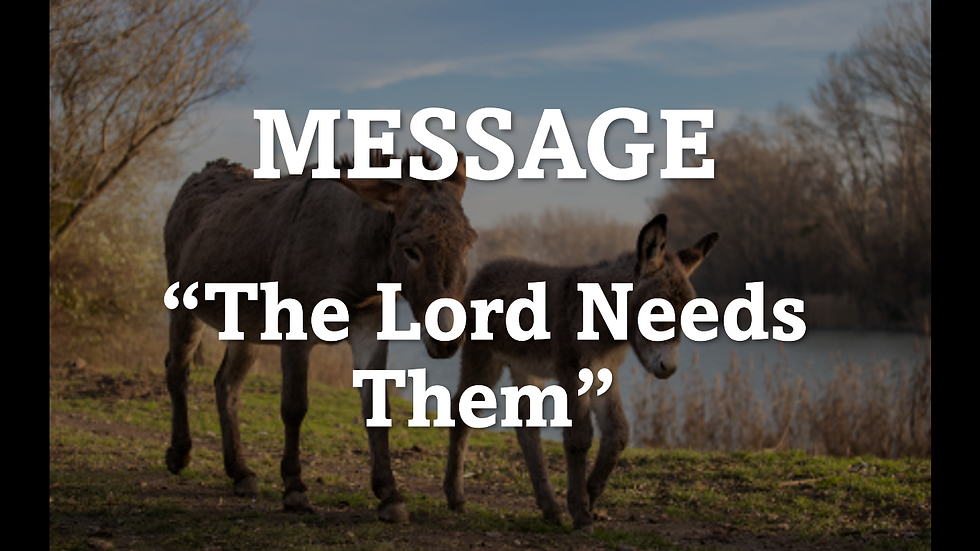
Let’s see how this scripture can help us answer that question. As Jesus prepares to enter Jerusalem, he tells his disciples to go ahead into the village, and says: “You will find a donkey tied, and a colt with her… Untie them and bring them to me. If anyone says anything to you, just say this: ‘The Lord needs them.’”
The Lord needs them. Not wants. Not prefers. Needs.
And that line sets the tone for everything that follows. Because what we see on Palm Sunday is not just a parade. It is a moment of revelation, a moment where people’s expectations collide with God’s reality.
So let’s begin there: Why did Jesus ride a donkey into Jerusalem? Because Jesus is making a statement. The people were expecting a Messianic King.
In the ancient world, kings didn’t ride donkeys when they entered a city. They rode war horses. They came with armor, with soldiers, with power on display.
But Jesus chooses a donkey, not by accident. Not because it was convenient. But because it fulfills the prophecy. “Look, your king is coming to you, humble, and mounted on a donkey.”
This is a different kind of king. Not one that comes on a war horse, but one that comes to bring peace. Not one who conquers by force, but one who comes in humility.
Not one who demands allegiance through fear, but one who invites love through sacrifice. Jesus is redefining power. He is saying that God’s kingdom does not look like the kingdoms of this world. And here is where the tension begins, because the crowd doesn’t fully understand that.
They shout, “Hosanna!” which means “Save us!” But what kind of salvation are they expecting? Freedom from Rome. Release from the captivity of political oppression.
They are expecting an immediate change. They want a king, but they want a king on their terms. A King that looks and acts like they expect a king to be. So this explains the question we get at the end of the scripture for today. “Who Is This?”
As Jesus enters the city, Matthew tells us the whole city is in turmoil. And the question rises from the crowd. “Who is this?”
It’s a simple question, but it is the most important question in the entire story. Who is this? The crowd answers. “This is the prophet Jesus from Nazareth.” And that answer isn’t wrong, but it isn’t sufficient.
In adventure club this week one of the kids was asked how do you know that and their answer was “because I know things”. It was a great answer and though not wrong, it didn’t really answer the question.
“This is the prophet Jesus from Nazareth.” Is kind of like that, it is not wrong, Jesus did speak and lead like a prophet, but Jesus is more than a prophet.
He is the Messiah.
The Son of God.
The one who comes not just to teach, but to save, and here is the truth we cannot avoid, how you answer the question “who is this” shapes everything.
If Jesus is just a good teacher, you can take or leave what he says. If Jesus is just a prophet, you can admire him from a distance. But if Jesus is the Lord, the promised Messiah, the one sent to save humanity... Suddenly, this isn’t just a question for the crowd. It becomes a question for us. Who is this Jesus to you?
Is he someone we celebrate when life is going well? Or is he our Savior, our refuge even when his way challenges everything we expected?
Answering that question takes us back to the question we started with. What happens when Jesus doesn’t meet our expectations? Because by the end of the week, everything changes. The same voices that shout “Hosanna” will cry out, “Crucify him!” This seems like a really fast flip flop, and I’m guessing that at some point you have all wondered, why? Why did they so quickly go from Hosanna to crucify him? The answer may seem overly simple: because Jesus did not become the king they expected.
Instead of overthrowing Rome, he overturns tables in the temple.
Instead of gathering an army, he gathers his disciples for a final meal.
Instead of seizing power, he allows himself to be arrested.
Instead of fighting back, he stands silent before his accusers.
And in that moment, when the crowd realizes that this is not what they wanted. When Jesus refuses to fit their expectations, it takes only a few voices to get them to turn from praise to ridicule. From celebration to condemnation.
Because it is easy to praise Jesus when we believe he will give us what we want.
But it is much harder to follow Jesus when he calls us to something unexpected.
The cries of “Hosanna” fade when the path leads somewhere uncomfortable. Not because Jesus changed, but because their expectations were revealed.
And this is where we return to that quiet, powerful line: “The Lord needs them.” Jesus chooses a donkey, this a humble, ordinary animal, to carry him into Jerusalem. This reminds us that God’s work is carried forward through ordinary things. Ordinary people. Unexpected vessels.
In seminary I wrote a sermon on Luke’s version of this story that took on the perspective of the colt. Perhaps I’ll bring in more from it sometime in the future, but what I want to share from that is this. The donkey doesn’t understand the moment. It doesn’t know it is fulfilling prophecy. It simply carries Jesus. And maybe that is the invitation for us. We don’t have to have everything figured out. We don’t have to be impressive. We don’t have to be powerful. But when the Lord says “I have need of you” are we willing to be used? Are we willing to carry Christ into the world?
Into our homes.
Into our community.
Into the places where hope feels thin?
Today is Palm Sunday. It is also known as Passion Sunday, because even as the crowds wave branches, the shadow of the cross is already falling. As Jesus rides into Jerusalem, he knows that this parade leads to betrayal.
To denial.
To suffering.
To the cross.
He rides into Jerusalem not as a victim of circumstances, but as one who is choosing the path of love all the way to the end. The same king who rides in humility on a donkey, is the same king who will carry a cross. The same crowd that welcomes him is the same crowd that will abandon him. He knows this and still, he comes.
So today, we are left with the question of the crowd, who is this? Is he the kind of king we want or the kind of king we need? Because the truth is, we often want a king who will fix our problems. But Jesus comes as a king who transforms our hearts. We want a King who wield power on our behalf, but Jesus brings humility and peace. We want a King who will control those we oppose, but Jesus brings surrender. We want victory over our oppressors, but Jesus carries the cross where he will die. Jesus, our promised Savior, doesn’t act as we expect.
And yet, He is the king who leads. He is the king who overcomes. He is the king who brings us hope. He is the king who saves us. So, as we enter this Holy Week, may we not just wave our branches and shout “Hosanna,”
May we also empty ourselves of our earthly expectations, and open ourselves to the truth of the answer to the question “who is this?” May we answer the question “Who is this?” with the confidence of those who know the grace and love of our Savior. May we march in the parade, following our king, even when the road leads somewhere difficult. And when the Lord says, “I need you.” May we be willing, like that humble donkey, to carry Christ into the world.
Amen.


Comments